Building an AI marketing OS my team actually uses
Summary
I lead marketing at Boundless, an AI infrastructure startup that helps teams run open AI models. My team was interested in AI, but the work still broke down when people had to leave Slack, rebuild company context, and figure out how to prompt a new tool. I interviewed the team about where they lost time, then built Gojo, a Slack-native marketing AI assistant that draws on the marketing intelligence I have built to help with copy, strategy documents, and delegated tasks. I designed the workflows, built the underlying context system in GitHub, and continue improving it based on how the team actually uses it.
- The team now uses Gojo inside Slack for copy, strategy documents, and day-to-day marketing work
- A Slack conversation can become a Google Drive document, task, spreadsheet, or reminder without switching tools
- The shared context lives in GitHub, where approved examples and refined skills can be reviewed and improved over time
Why I built Gojo
ChatGPT and Claude have made it easier for teams to share context, but day-to-day AI use is still uneven. One person might have a sophisticated workflow while another is unsure where to begin, and people end up copying messages between tools, rebuilding context, and searching for the right prompt or skill.
That matters to me as a marketing leader because I see part of my role as helping the whole team get more leverage from AI. The system has to work for different levels of fluency and carry the company's standards into the work, so people can move quickly without splintering into their own approaches.
That is why I started building Gojo, a Slack-native marketing AI assistant. Slack is where briefs, feedback, and decisions already move through the team, so Gojo can meet people where they work while drawing on shared company context, specialist skills, and the live conversation in front of them.
Building the marketing brain behind Gojo
I called the assistant Gojo after my favorite Jujutsu Kaisen character. Building his marketing judgment began before anyone could tag him in Slack, and I treated the process a little like fine-tuning a model.
I created dozens of case studies on companies whose marketing I admire, studying their product launches, events, social content, tone of voice, copy, and how each piece fits together. I used conversations with ChatGPT and Claude to interrogate the work, extract my takeaways, and turn them into focused skills and Markdown files.
Those files live in a private GitHub repository that acts as Gojo's brain. Alongside the broader marketing research, it holds company-specific context: our positioning and messaging, product truth, tone of voice, and brand guidance. When someone tags Gojo in Slack, they are drawing on that work, and I keep steering and updating it as the product matures.
Interview the team before choosing features
I treated my teammates as users and interviewed them about the work they repeated, the context they regularly had to reconstruct, and the artifacts they needed to create. Their answers shaped the roadmap more than a generic list of what an AI agent could theoretically do.
One of those conversations was with Natalia, our events lead. She often needs to turn an event plan into smaller tasks for designers and other collaborators, so we built a workflow that lets her ask Gojo to create them directly in Slack with the right owner, due date, and context.
| Team need | Existing behavior | Gojo workflow |
|---|---|---|
| Iterate on copy | Collaborate inside Slack threads | Read the conversation and respond in context |
| Develop strategy | Discuss in Slack, then move into Google Drive | Create a linked Google Doc from the conversation |
| Delegate production work | Assign small tasks through Slack | Create a Slack List task with context and ownership |
| Study good launches | Post links to launches and announcements | Study the source and retain reusable lessons |
| Coordinate follow-ups | Send reminders in Slack | Schedule a message in the right channel, thread, or DM |
The interviews changed the product from a general-purpose assistant into a set of native workflows tied to the way the team already operated.
Put the interface where the work already happens
A teammate can mention Gojo inside an active Slack conversation. Gojo reads the complete thread, adds relevant channel context when needed, and combines that live conversation with the durable intelligence inside the Marketing OS. The teammate can continue the work without preparing a new brief or explaining the company from the beginning.
That same interface supports quick copy exploration, deeper strategic questions, and requests for artifacts. A short copy exercise can stay in the thread, while a larger piece of work can become a linked document or spreadsheet without losing the context that produced it.
Keep marketing judgment in version control
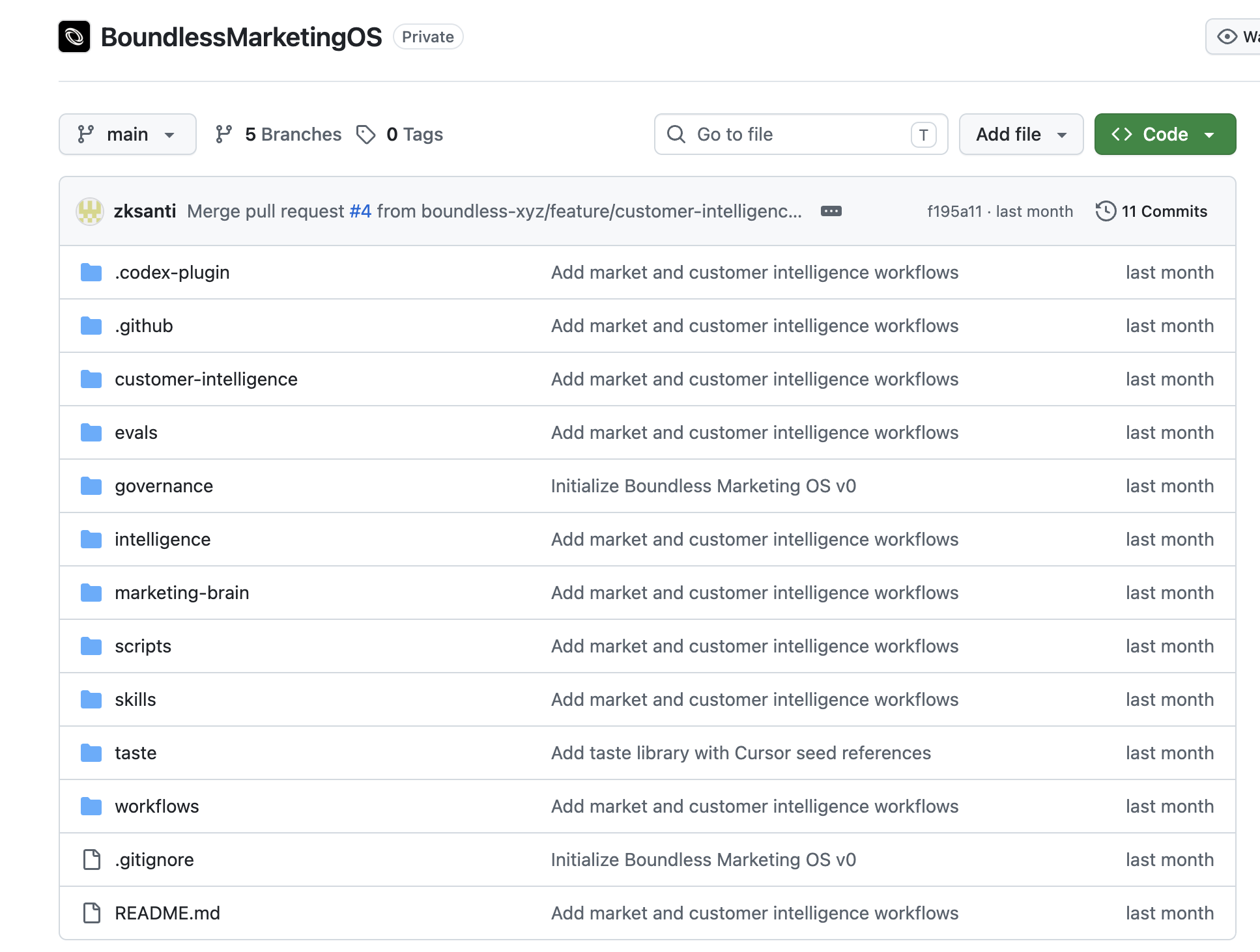
I organized the Marketing OS into deliberate layers. The Marketing Brain holds approved positioning, audiences, product truth, proof status, brand rules, and refined skills; owner-controlled project memory holds durable context for specific initiatives; and Slack provides the immediate task context. I keep the system in a private GitHub repository with its workflows, taste library, retained intelligence, governance rules, and evaluations so the team can inspect and improve it over time.
Each skill is a versioned artifact with a focused job. Feedback can become a skill change, tested against evaluation cases and reviewed before it reaches the team. Git history keeps every change visible and reversible, while named owners control updates to company truth and durable project memory.
This separation allows Gojo to understand the team without treating every Slack message as permanent truth. A conversation can change the current answer, but it cannot silently rewrite company positioning, approve a claim, or alter project memory. Durable changes require an explicit owner decision.
Keep learning from good launches
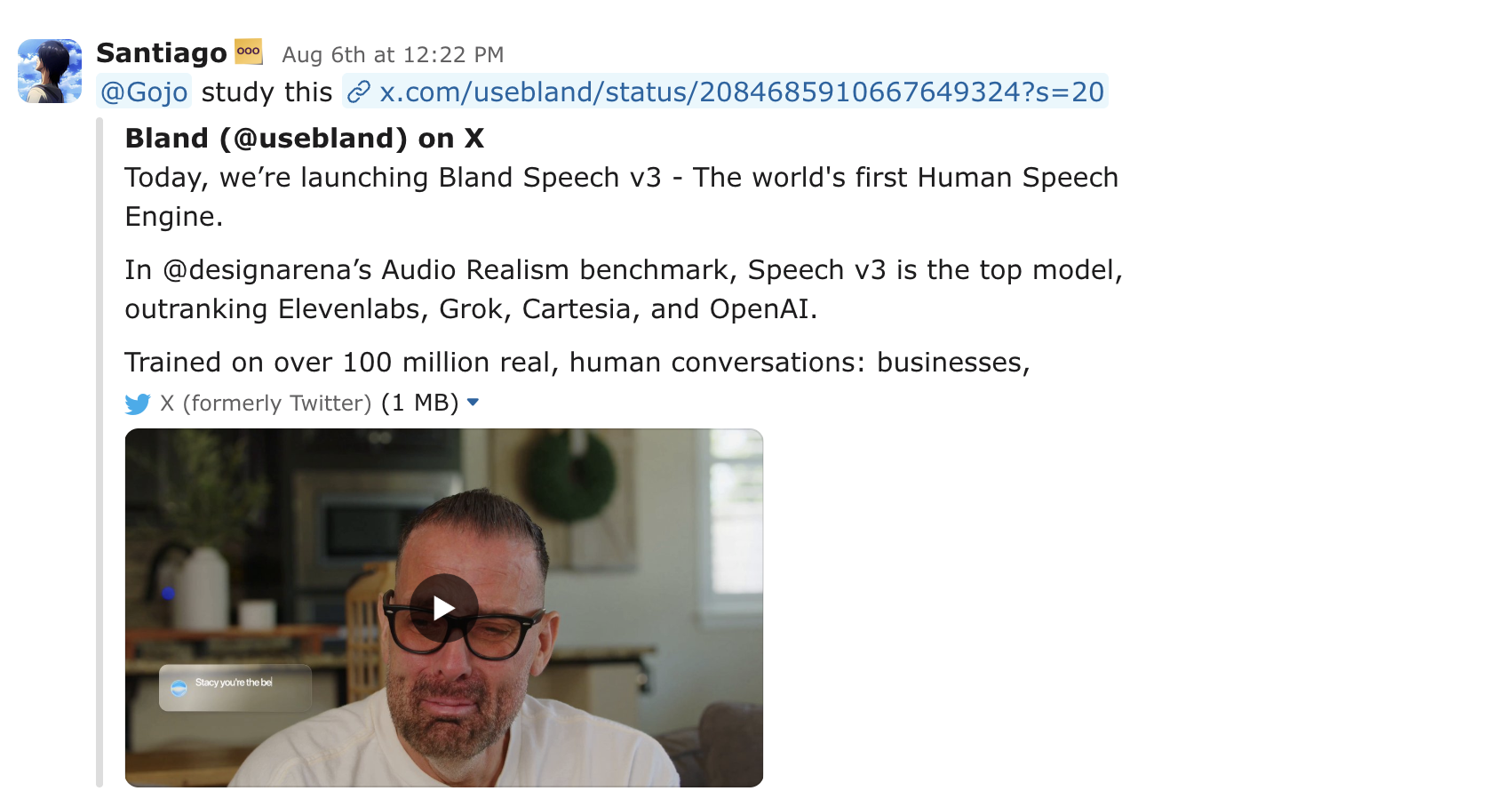
Our team regularly shares launches and announcements we admire in Slack. I turned that existing behavior into a learning workflow: tag Gojo with ‘study this’ and a source link, and the system researches the announcement, distills a structured report, and retains the useful lessons for future work.
Gojo looks at the audience, message, narrative structure, assets, channels, sequencing, proof, and call to action. It separates what worked in that company’s specific situation from mechanisms that may transfer to a future company launch, then stores those lessons with their sources and boundary conditions.
When the team later asks Gojo to plan or pressure-test a launch, the relevant lessons can return alongside the company’s approved context. The library grows as the team contributes examples and decides which patterns are worth keeping.
I think of this as fine-tuning the team’s marketing context, even though the base model itself is unchanged. The lessons come from governed memory, which keeps them inspectable, attributable, reversible, and separate from approved company truth.
Connect thinking to execution
Gojo is most useful when it can carry a decision into the team’s operating tools. It can create private Google Docs and Sheets, schedule Slack reminders, and create Slack List tasks when a teammate explicitly requests the action.
The task workflow came directly from the events interview. A planning conversation can now become a delegated task with a title, description, assignee, and due date. Strategy work can become a Google Doc linked back into Slack, giving collaborators an editable artifact without losing the conversation that shaped it.
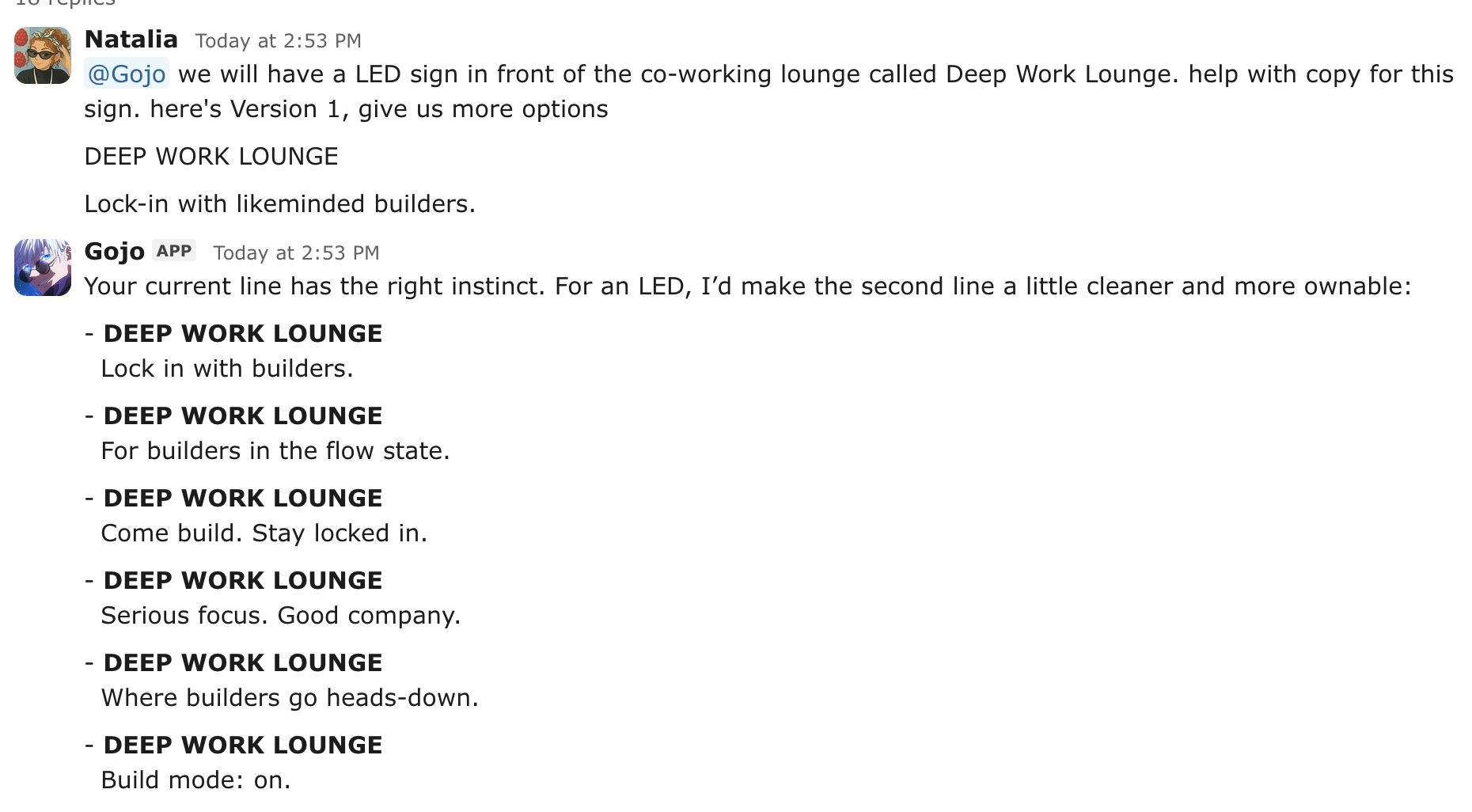
Teammates are already using Gojo for both ends of that spectrum: quick copy collaboration inside Slack and more substantial strategy documents delivered through Google Drive.
Build trust into the operating model
A shared AI teammate needs clear rules for truth, memory, permissions, and external actions. The Marketing OS separates approved facts from working hypotheses, preserves source status, and requires human review before externally directed work is published or sent.
Gojo also uses narrow permissions. Slack conversations cannot update durable project memory, external writes require explicit intent, and the system confirms a document, reminder, or task only after the destination accepts it. Market examples can inform future judgment, but they cannot become approved proof or silently change the company’s strategy.
These constraints make the system easier to trust because teammates can understand what Gojo knows, where that knowledge came from, and which decisions remain human.
How the team started using Gojo
The most meaningful early result is that the team has started using Gojo in real work. Teammates call on it as a copy thought partner inside active Slack threads, and others use it to develop strategy documents that are delivered through the company’s Google Drive.
People use Gojo because it fits the way the team already communicates, preserves the context behind a request, and can carry the work into a next action.
Repeated use makes Gojo more useful because its answers begin with shared context, approved learnings can be reused, and new capabilities come from real team needs.
Building an AI agent for your team?
If you are a founder or marketing leader building an AI agent for your team, I would be happy to compare notes on context design, workflows, and getting people to actually use it.